
Polictics of land and life
THE GILGIT BALTISTAN LIMBO
Writer: Schatz
Ever wondered why does land hold such importance to the natives?
On the 5th of July 1830, Act of Capitulation was signed between the French army and Dey Hussein, ruler of Algeria, which stated that no harm would be done to the natives under the French rule. But moments after the it was signed, the colonial administration confiscated fertile lands from the original Algerians, leaving local inhabitants impoverished and driven into barren areas.
“5th of July 1830, Act of Capitulation was signed.”
Decades later, an Algerian psychiatrist and political philosopher, Frantz Fanon, one of the giants of the modern world, writes in his famous book The Wretched of the Earth that “for a colonized people, the most essential value, because it is the most meaningful, is first and foremost the land: the land, which must provide bread and, naturally, dignity” (pg. 35).
For Fanon, as mentioned by Stephanie Clare in her article “The Politics of Life and Land,” published at Johns Hopkins University, “life is inextricable from land.” It is the land that gives life to the colonized, for the simple reason that it gives food, and therefore, dignity to the colonized. She further writes that the land matters to the colonized not as an abstract ideal (like Western “dignity” or “values”) but because it literally produces bread. In Fanon’s own words: “To live simply means not to die. To exist means staying alive. Every date grown is a victory. Not the result of hard work, but a victory celebrating a triumph over life.”
“Life is inextricable from land. Every date grown is a victory. Not the result of hard work, but a victory celebrating a triumph over life.”
Unlike Foucault, as discussed in a previous post by Schatz, Fanon thinks that “power comes to target the life of the colonized by tracing a relationship between the occupation of the land and the occupation of the minds and bodies of the colonized. The techniques for the occupation of land include violence and law, but also urban planning, agriculture, and engineering” (Clare, 14).
“Power comes to target the life of the colonized by tracing a relationship between the occupation of the land and the occupation of the minds and bodies of the colonized.”
If not under colonial power anymore why still do people rise, in unprecedented numbers, against the enacted laws and reforms of the state?
In the past few years Gilgit Baltistan has seen an unprecedented development plan that seems to contradict the natives’ demands. While the topography of Gilgit-Baltistan, carved by mountains and fragile ecosystems, was never made to sustain the weight of a concrete dystopia. Be it Minawer, where people protested the state claim over their land, or the concrete dystopia built around Attabad lake, Hunza.
“The topography of Gilgit-Baltistan, carved by mountains and fragile ecosystems, was never made to sustain the weight of a concrete dystopia.”
The land, in any way, cannot be confiscated from the natives by anyone, even the state, for it holds, as Fanon mentions, the very meaning for man.
The people of Gilgit-Baltistan, if not the masses, then at least some of the progressive movements, have been raising the same concerns Fanon once raised in Algeria. Writing in Beyond the Mountains, a groundbreaking collection of essays and articles that delve into the complexities of Gilgit-Baltistan, Dr. Nosheen Ali writes that “a comparison to the Native American situation is now increasingly made in the region which was not the case a decade ago and has only emerged in the last three years.”
Schatz is not, in any way, deducing whether Gilgit-Baltistan is under colonial power or not, that is not the matter this article ponders upon. The purpose of the connection made between 1830 Algeria and today’s Gilgit Baltistan, and surely the purpose of the whole article, is to stress upon the idea that the laws must protect the native’s land and his ownership over it not the other way around. That before any changes can surface, the natives, and above all, the youth, must be aware of what is happening in his/her own backyard.
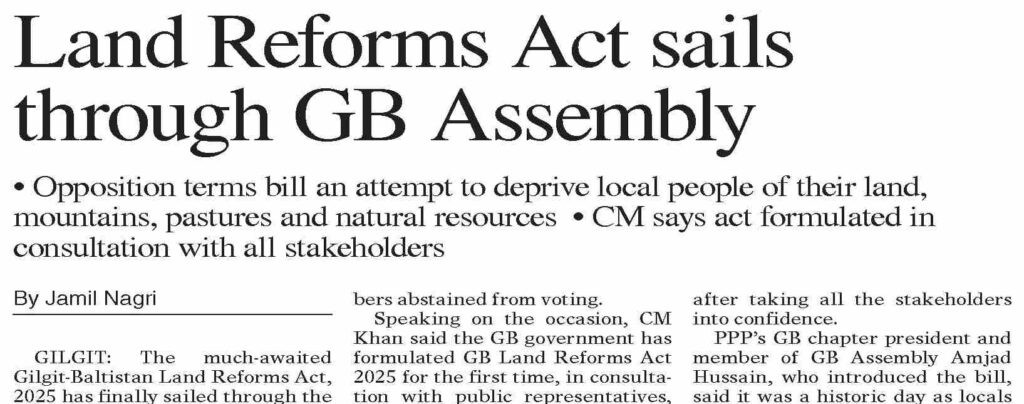
But the recent laws like Land Reforms Act 2025, with all its flaws, as were pointed out by the opposition, replaced the former colonial laws, the Khalisa Sarkar laws, with local laws showing a promising future for the natives of Gilgit Baltistan. But a secure and progressive future can only be manifested into reality when, as mentioned by Dr. Noreen, an occupier imaginary does not merge with a puritanical project which seeks to deny the right of religious, political, and cultural existence to local inhabitants, and deprive them of their traditional lands.